Preventable,
Yet The Deadliest
Detecting Lung Cancer Early
Gives The Best Chance Of Beating It
Detecting Lung Cancer Early
Gives The Best Chance Of Beating It
ON ITS ORIGIN

The location in the lung where cancer started determines its type:
- 1 -
Non-small cell lung cancer (NSCLC)
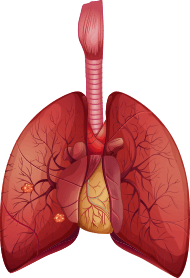
Adenocarcinoma
(most common form, starts in the mucus making gland cells in the lining of the airways)
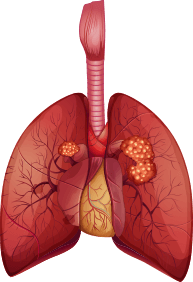
Squamous Cell Carcinoma
(develops in the flat cells that cover the surface of the airway and tends to grow near the centre of the lung)
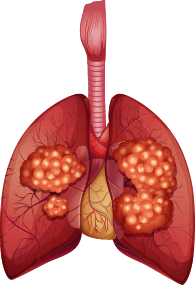
Large Cell Carcinoma
(appears large and round under a microscope)
- 2 -
Small cell lung cancer (SCLC)
Lung cancer is broadly classified into two main types based on the characteristics of the cancer cells[5].
Non-Small Cell Lung Cancer (NSCLC): The most common type, accounting for approximately 85% of all lung cancer cases.
Small Cell Lung Cancer (SCLC): A less common but more aggressive type.
The stages of lung cancer depend on whether the cancer is local or has spread from the lungs to lymph nodes or other organs. Because the lungs are large, tumors can grow in them for a long time before they are found. Even when symptoms do occur, people think they are due to other causes, so early-stage lung cancer is difficult to detect [5].
Stages Of Non-Small Cell Lung Cancer (NSCLC):
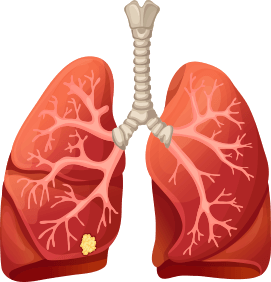
Stage I [5]
Early Detection Is KeyThe cancer is located only in the lungs and has not spread to the lymph nodes.
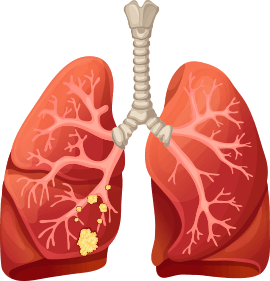
Stage II [5]
The cancer is in the lung and nearby lymph nodes.
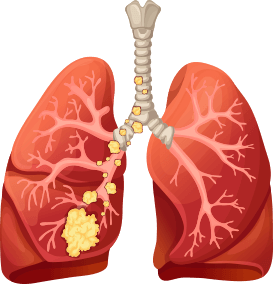
Stage IIIA [5]
If the cancer has spread only to lymph nodes on the same side of the chest where the cancer started, it is called stage IIIA.
Stage IIIB [5]
If the cancer has spread to the lymph nodes on the opposite side of the chest, or above the collar bone, it is called stage IIIB.
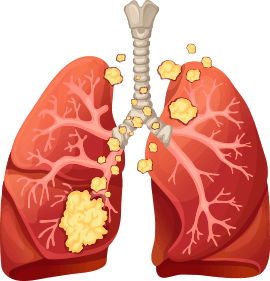
Stage IV [5]
This is the most advanced stage of lung cancer where the cancer has spread to both lungs, to fluid in the area around the lungs, or to another part of the body, such as the liver or other organs.
Stages Of Small Cell Lung Cancer (SCLC):
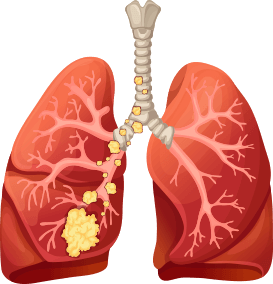
Limited Stage [5]
In this stage, cancer is found on one side of the chest, involving just one part of the lung and nearby lymph nodes.
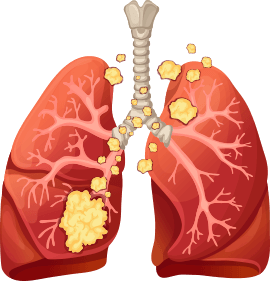
Extensive Stage [5]
In this stage, cancer has spread to other regions of the chest or other parts of the body.
LUNG CANCER CAN BE DETECTED NON-INVASIVELY WITH A LIQUID BIOPSY
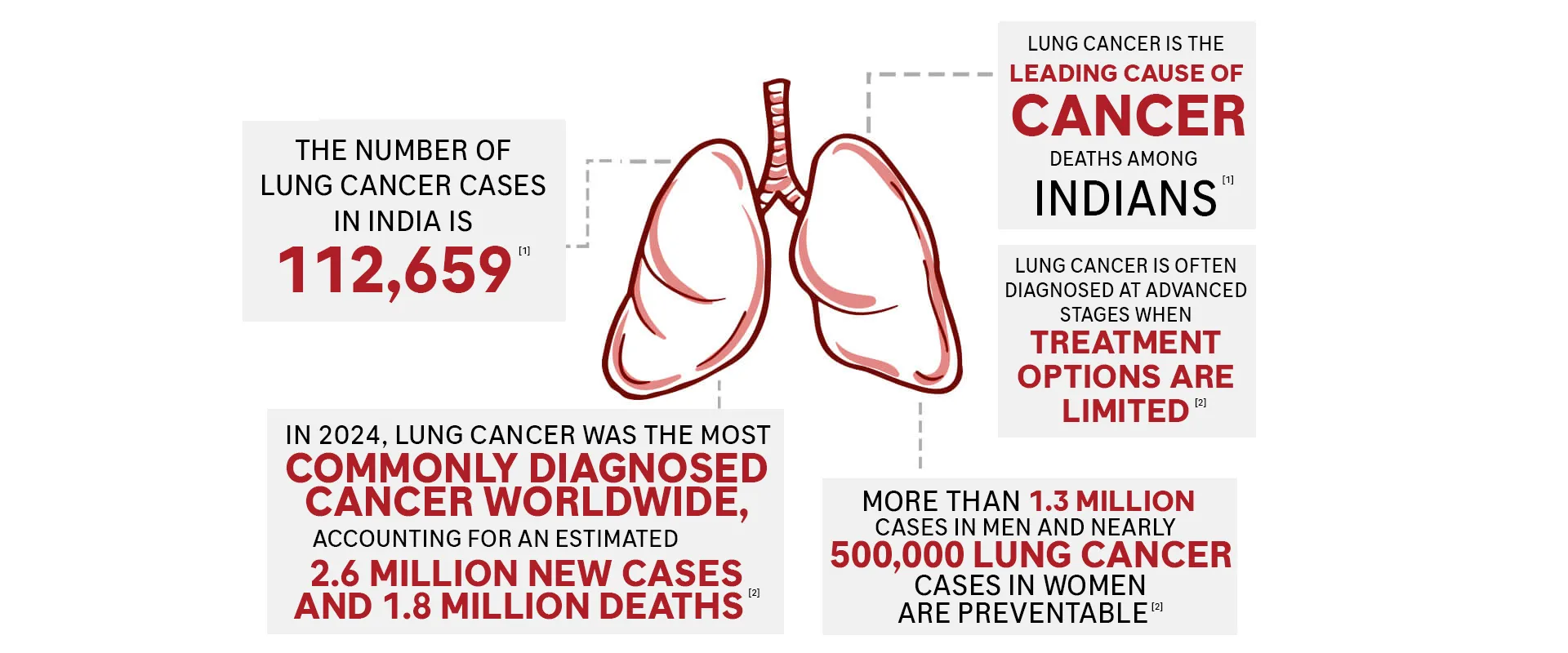
Despite significant advances in medical care, lung cancer remains one of the leading causes of cancer-related deaths worldwide. Early detection through screening offers the best opportunity to improve survival and reduce mortality by enabling treatment at an earlier stage. However, treating advanced lung cancer continues to be a major clinical challenge[6].
The overall 5-year relative survival rate for lung cancer is 28.1%. However, survival outcomes vary significantly depending on the stage at which the disease is diagnosed[7].
1. https://gco.iarc.who.int/media/globocan/factsheets/populations/356-india-fact-sheet.pdf
2. https://www.who.int/news-room/fact-sheets/detail/lung-cancer
6. https://www.sciencedirect.com/science/article/pii/S075333222301689X
7. https://www.cancertherapyadvisor.com/factsheets/lung-cancer-survival-rate/